
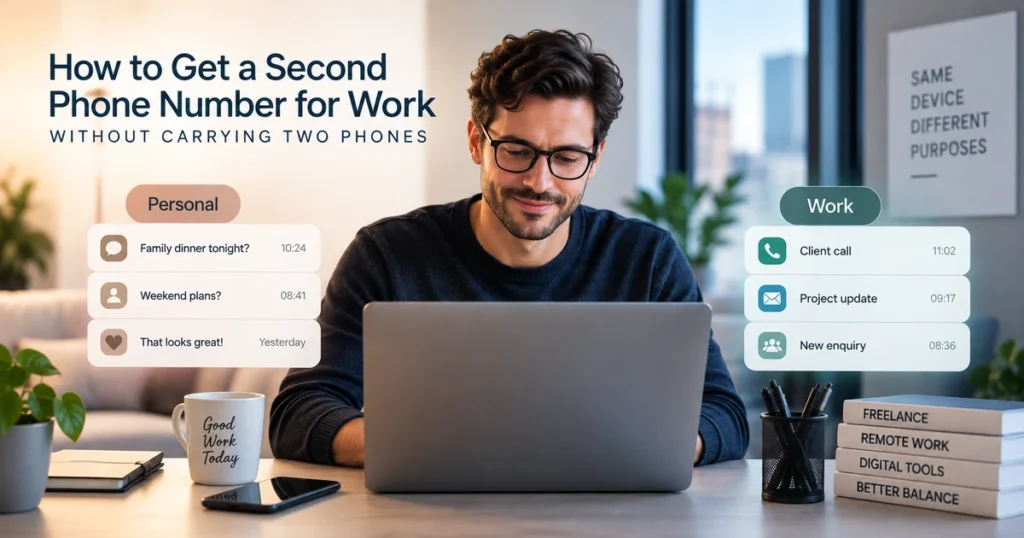
A second phone number does not necessarily require a second phone.
For a freelancer, consultant or small business owner, the practical problem is often simple: clients need a number to call, while publishing a personal mobile number everywhere feels unnecessary.
You can add a physical SIM, activate an eSIM, or use a virtual number that handles calls and messages through an app or browser. These options solve different problems.
Quick take
A virtual work number makes sense when you want a public client number, ordinary calls and SMS on devices you already own, browser access, voicemail, or forwarding. Choose a carrier SIM or eSIM when mobile-network identity, banking verification, or OTP compatibility is critical.
Start with the problem, not the phone plan
Before comparing providers, decide why you need the number. A freelancer putting a number on a portfolio has a different requirement from somebody opening a bank account. A small support team has a different requirement from somebody travelling and looking for cellular data.
Personal number
- friends and family
- private accounts
- primary mobile identity
Work number
- client enquiries
- website and contact page
- project calls and messages
Physical SIM, eSIM and virtual number are not the same thing
They can all give you another number, but the underlying connection differs.
Physical SIM
A carrier-issued SIM. Best when conventional cellular service, mobile verification, or a number tied directly to a carrier subscription matters.
Trade-off: you may need another SIM slot or another device when your phone cannot support multiple active lines.
eSIM
An eSIM is still a mobile carrier SIM profile. GSMA describes it as a securely downloadable profile, so it can provide standard mobile service without a removable card.
- your phone supports multiple SIM profiles;
- you want a proper carrier line without another physical card;
- cellular data and standard mobile service matter.
Virtual number
Internet-based telephony accessed through an app or browser. This is particularly appropriate when:
- the number is mainly for work;
- browser or app access matters;
- calls and ordinary SMS matter more than carrier identity;
- you want to keep a personal number out of public-facing business communication.
What a virtual work number looks like in practice
Imagine a solo consultant whose personal number stays private while the website displays a separate work number. A client calls it, and the call is answered through a browser or compatible app. Depending on the service, unanswered calls may go to voicemail or be forwarded elsewhere.
- Client
- Work number
- WebPhone or app
- Answer, voicemail or forwarding
The result is not a second phone. It is a second communication channel.
Where this setup works well
- freelancers publishing contact details on a portfolio
- consultants keeping a private number out of search results
- small businesses needing a basic public phone line
- remote workers answering calls from a laptop
- side businesses not ready for a full phone system
It can also help when you move between devices because a browser-based phone line is not tied to the physical SIM slot in one handset.
People who want a clearer boundary between private and business conversations can keep incoming work messages inside the service dashboard instead of mixing them with private conversations.
What changes when you work from a browser
A browser-based line is useful only if it fits your working habits. Decide where calls should be answered during working hours, who checks messages when you are away, and whether forwarding is an exception or the normal route. A simple rule such as “answer in the WebPhone first, forward only when necessary” keeps costs and missed calls easier to understand.
It is also worth treating the number as business infrastructure. Keep the login details in your normal account system, document who can access it, and make sure a client can still reach someone if you take a day off.
One option that fits this workflow
2ndNumber is one example of a virtual-number service built around calls, SMS, and browser-based access. Its WebPhone can be used from a computer for calls, while SMS conversations are available through the web dashboard. The service also describes voicemail and call forwarding features.
That makes it more relevant to a freelancer who wants a separate client-facing number than to somebody looking only for extra mobile data while travelling. Number availability, plans, and calling costs can change, so check the current options for the country and number type you need.
The important limitation: verification codes
A number that receives an ordinary SMS is not automatically accepted as a verification number by every bank, app, or online service. Platforms may identify virtual or VoIP numbers differently from conventional mobile numbers. Some reject them, while others accept only particular countries, number ranges, or methods.
2ndNumber’s support material warns that banks and apps increasingly require physical SIM-based mobile numbers. WhatsApp and similar platforms can also impose restrictions on VoIP numbers.
Calls and SMS can have separate usage costs
A subscription price is not always the full communication cost. 2ndNumber support explains that calling and sending SMS can consume credits depending on the destination, while receiving calls and messages may follow different rules. Call forwarding can also consume credits because the service places the forwarded leg.
- monthly or annual number cost
- included credits
- outgoing call and SMS rates
- forwarding charges
- international destination pricing
A cheap number can become expensive when the usage pattern differs from the base plan.
Ordinary communication is different from account identity
This distinction is easy to lose when a service advertises calls, SMS, and verification in the same place. Receiving a message from a client is an ordinary communication task. Proving ownership of a bank or app account is an identity task controlled by the receiving platform.
Even where a provider says numbers can be used for verification, the final decision belongs to the service sending the code. Number type, country, carrier rules, account history, and fraud controls can all affect delivery. Treat verification as a requirement to test, not as a feature to assume.
Test the workflow you actually need
- Can a new client call from the countries where most clients are based?
- Can you answer from the device you normally use?
- Can you receive ordinary SMS reliably?
- What happens when you miss a call?
- Can calls be forwarded when necessary?
- Is voicemail available?
- Can work messages stay separate from personal conversations?
- What does an outgoing call or SMS cost?
- Does it work for any specific service you absolutely need?
Test that last question separately. A number that works for client calls tells you nothing about whether a bank accepts it for login verification.
A simple setup for a freelancer
- Public website
- Work number
- Browser or app during working hours
- Missed call → voicemail or forwarding
- Personal mobile → stays private
This creates a useful boundary without adding another device. The work number becomes part of the business infrastructure rather than part of your private identity.
That kind of ownership and recovery planning also belongs in a broader digital operations checklist for small teams.
When an eSIM is probably the better answer
A virtual number is not automatically the best way to get a second line. Choose a carrier SIM or eSIM instead when dependable SMS verification is central, cellular data is needed on the second line, standard carrier-level mobile service is needed, the number will be used for regulated or high-trust accounts, or you want the fewest possible VoIP compatibility questions.
A second eSIM can keep personal and work numbers on one compatible phone, while the second line remains a conventional carrier service.
What to check before buying a virtual number
- Number location. Confirm the country or area you need is currently offered.
- Incoming communication. Decide whether you need calls, SMS, or both.
- Outgoing communication. Check destinations and how actions are billed.
- Verification requirements. List every account that must accept the number. Do not assume compatibility.
- Fallback. Decide what happens when you cannot answer. Voicemail, forwarding, and browser access matter.