
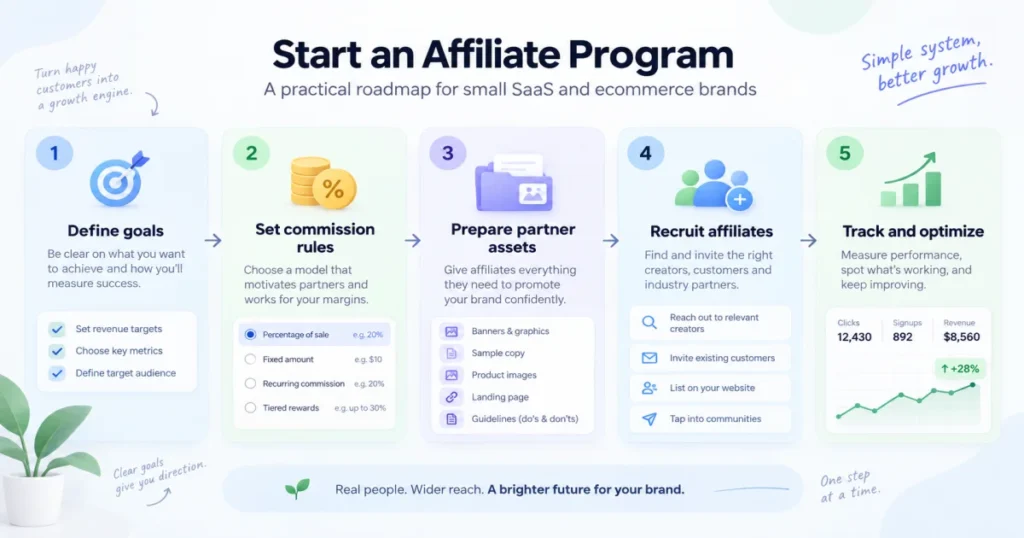
For a small SaaS or ecommerce company, the best first program is usually narrow. One audience, one offer, one conversion definition, and a manageable group of partners make it easier to learn without creating a large administrative burden.
Quick answer: Define the economics, choose a specific partner profile, document the rules, connect reliable tracking, recruit a small first cohort, and review approved revenue rather than registrations alone. Expand only after attribution and payouts work correctly.
Before you choose affiliate software
A proven offer
Know which product and conversion partners will promote.
Working economics
Set a reward the margin can support after refunds and operating costs.
A partner profile
Identify the people or businesses that can reach suitable customers.
Tracking requirements
Document the checkout, subscription, coupon, and attribution events that must be recorded.
If these decisions are still open, software will give the uncertainty a dashboard. Resolve them first, then evaluate tools against the workflow you actually need.
Define the goal before choosing software
Write down the business outcome in one sentence. A SaaS company might want consultants to introduce qualified trial users who become paying customers. An ecommerce store might want niche publishers to generate first-time orders without depending entirely on paid advertising.
Choose one primary conversion: an approved paid subscription, a completed order, or another event with measurable value. Avoid paying for vague engagement unless you have a reliable way to validate quality.
- Average order value or subscription revenue
- Gross margin after delivery costs
- Refund, cancellation, and chargeback rate
- Acceptable customer acquisition cost
- Time needed to support partners and review commissions
Decide which partners you want
- Educators and reviewers
Useful when customers research the category before buying and need detailed explanations. - Consultants and agencies
Relevant for SaaS products that become part of a client workflow or implementation. - Creators and influencers
Strong when the product can be demonstrated clearly and the audience trusts the creator. - Existing customers
Suitable for a simpler referral model when satisfied users already recommend the product.
Describe the ideal partner in operational terms: audience, channel, subject expertise, geography, promotion method, and expected content quality. This makes recruitment and application review more consistent.
Choose a commission model
A percentage commission follows order value, while a fixed commission provides a predictable cost per approved conversion. Subscription businesses may offer a one-time reward, recurring payments for a defined period, or a capped lifetime arrangement.
Simple SaaS pilot
Pay a fixed reward after the referred account completes its first paid billing period and remains outside the refund window.
Ecommerce pilot
Pay a percentage of eligible net order value, excluding taxes, shipping, refunds, and prohibited coupon use.
Illustrative economics, not a universal formula
- Product revenue: $100
- Gross margin after delivery costs: $65
- Amount reserved for overhead and contribution: $25
- Maximum acquisition budget: $40
- Possible affiliate commission: $20, leaving $20 for software, partner operations, uncertainty, and other acquisition costs
Model several real transactions before publishing the rate. Include software, payout, creative, fraud-review, and support costs. A generous percentage is not sustainable if the underlying margin is weak.
Write rules partners can actually use
The terms should explain eligible transactions, attribution, cookie duration, payout thresholds, validation periods, refunds, self-referrals, coupon behavior, prohibited traffic, paid search rules, trademark use, and disclosure requirements.
Create a shorter operating guide alongside the legal terms. Partners need practical answers: approved landing pages, accurate product descriptions, available assets, contact details, and examples of claims they must not make.
Do not leave brand bidding or disclosure expectations implicit. Ambiguous rules create disputes after traffic and money are already involved.
Prepare tracking and the partner experience
- Choose the destination.
Send partners to a page that matches the promise they are making. - Connect attribution.
Install the appropriate integration and define the conversion event. - Run controlled tests.
Verify click, signup, purchase, refund, and recurring-payment behavior. - Prepare onboarding.
Collect the information needed to approve and pay partners. - Document review.
Decide who approves applications, commissions, and exceptions.
If you need dedicated software for these operations, this Tapfiliate review explains its plan structure, tracking, commission tools, and likely fit for a small team.
Before inviting anyone, write down how a disputed conversion will be investigated and how corrections will reach the partner. A clear record of test orders, attribution windows, refunds, and manual adjustments protects both sides. It also gives the program owner a repeatable process when an edge case appears during the first live campaign.
Recruit the first partners
Begin with people who already understand the product or the problem it solves. Look at existing customers who already recommend it, niche creators who teach the relevant problem, consultants or agencies that influence tool choices, complementary businesses serving the same audience, and people in the founder or team’s professional network.
Prioritize relevance over reach. A consultant with twenty suitable clients may be a better first partner than a broad creator whose audience has little reason to buy. Record why each prospect fits, which offer they should promote, and what support they will need.
Send a personal invitation that explains why the partnership fits their audience. Include the product use case, commission model, validation period, available assets, and the person they can contact. Do not lead with commission alone.
A first cohort of five to twenty relevant partners is enough to expose onboarding gaps. Watch where they pause, what links they request, and which product claims require clarification.
Prepare useful partner assets
Give partners material that helps them explain the product accurately without forcing every promotion into the same template. A useful starter pack can include approved product screenshots, a short positioning note, feature definitions, audience examples, disclosure guidance, and links to current pricing or policy pages.
Separate factual reference material from optional campaign ideas. Mark outdated screenshots and retired offers clearly, and keep one person responsible for replacing them. If a partner asks the same question twice, add the answer to the onboarding guide rather than solving it privately each time.
Assets should reduce uncertainty, not encourage copy-and-paste promotion. Partners still need room to communicate in a voice their audience recognizes.
Track results and improve the program
Registration count is a weak success metric. Track approved partners, active affiliates, qualified clicks, conversion rate, approved revenue, revenue per active affiliate, commission cost, refund rate, and the share of affiliates generating at least one approved sale.
- Partner activation
The share of approved partners who publish and generate qualified activity shows whether onboarding and the offer are working. - Conversion quality
Conversion rate, approved revenue, and refunds show which partners reach suitable customers rather than merely producing clicks. - Revenue concentration
Revenue per affiliate and the share generating sales reveal whether the program depends on one partner or has a broader productive base. - Operating cost
Commission, payout fees, support time, disputes, and asset work show the real cost of the channel.
Use the answers to improve the landing page, partner brief, commission model, and recruitment criteria. Increasing the rate is not the only way to improve performance.
Common mistakes to avoid
- Launching without prospects.
Software is configured, but no suitable partners have been identified. - Copying a competitor rate.
The commission is disconnected from your own margin and retention. - Testing only the happy path.
Refunds, duplicate conversions, coupons, renewals, and failed payments are ignored. - Providing weak assets.
Partners improvise claims because accurate messaging and product material are unavailable. - Recruiting too broadly.
Application volume grows while relevance and partner support decline. - Paying before review.
The validation period does not account for cancellations, returns, or policy breaches.
A simple launch checklist
- One measurable program goal and conversion event
- Documented partner profile and approval criteria
- Commission model tested against real margins
- Terms covering traffic, attribution, refunds, and disclosures
- Tracking tested through conversion and reversal
- Approved links, copy guidance, images, and contact details
- Named owner for applications, commissions, and partner support
- First partner cohort identified before launch
A repeatable setup template
- Goal: state the approved conversion and business outcome.
- Partners: define audience, channel, geography, and expertise.
- Economics: record reward, validation period, exclusions, and margin.
- Attribution: document link, coupon, cookie, and recurring-payment logic.
- Enablement: prepare terms, messaging, assets, and onboarding.
- Operations: assign application, commission, support, and payout owners.
- Pilot: recruit a small cohort and review results on a fixed schedule.
- Expansion: scale only after tracking and partner support are reliable.
Complete this template before opening applications. Any blank field represents a future decision that will otherwise be made under pressure.
Sources and further reading
- Tapfiliate Help Center: program launch sequence
- Tapfiliate Help Center: tracking and attribution
- FTC: disclosure guidance for influencers
Affiliate laws, platform rules, tax obligations, and disclosure requirements vary by location and business model. Obtain appropriate professional advice for your program.